Winged, on all fours or slithering around: when it comes to jewellery, animal mascots come in all shapes, sizes and guises. It’s a design feature with history. Consider, for example, the animal motifs chosen by aristocratic families, guilds and royal courts to signal influence, power and, above all, centuries-spanning lineage. Henry VIII and Elizabeth I chose greyhounds — symbols of speed and loyalty; in France, Francis I, who reigned from 1515 to 1547, favoured the salamander, for resilience against fire and temptation.
Big cats have long been popular mascots. In a November 1990 issue of Country Life, Diana Scarisbrick enthused that ‘of all the naturalistic themes which have inspired jewellers since Antiquity, none strike the imagination more powerfully than the monarchs of the animal kingdom: lions, tigers and panthers.’
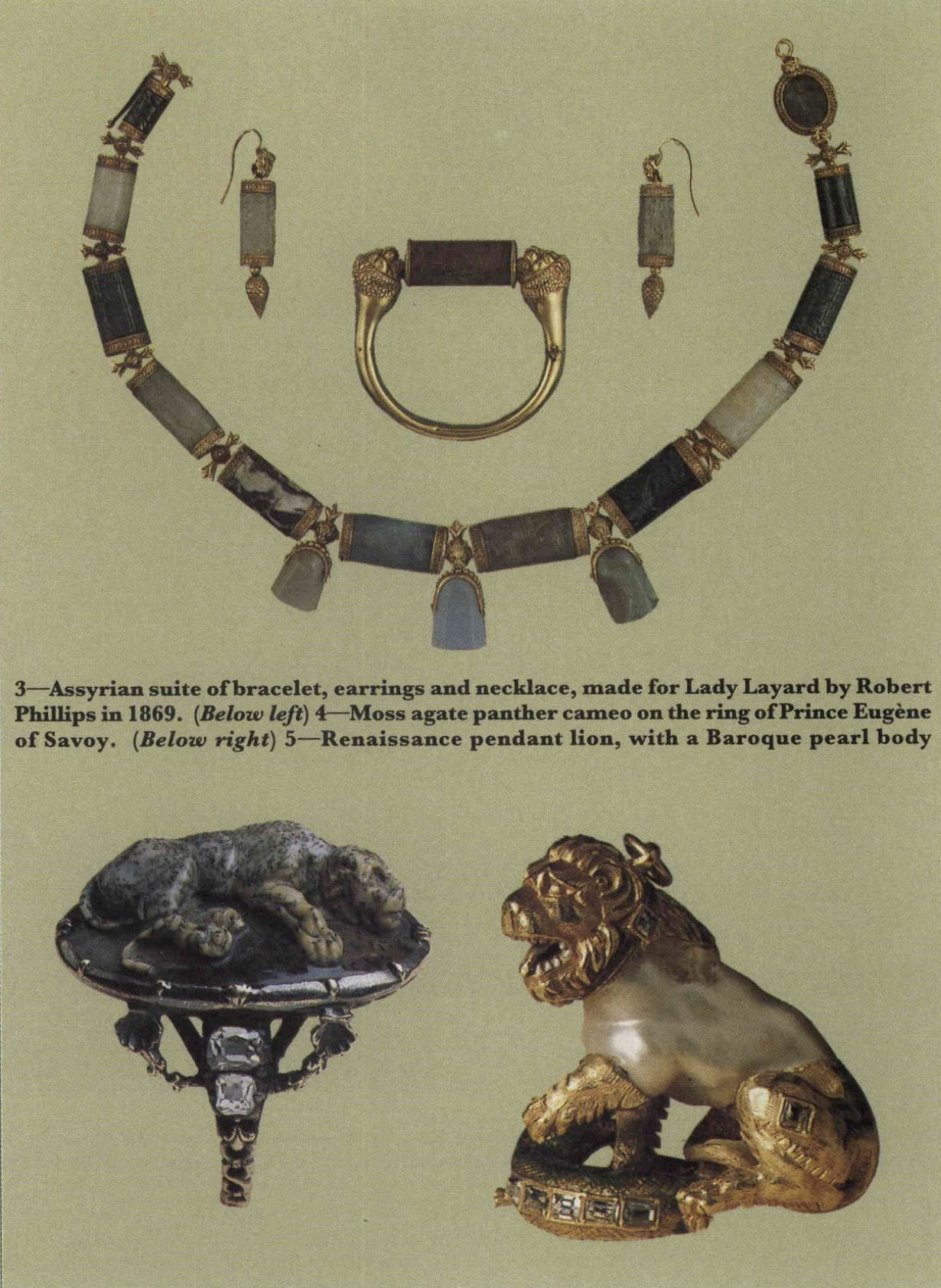
This box out originally appeared next to Diana Scarisbrick’s 1990 article on animal mascots. The Assyrian suite is in the British Museum, Prince Eugene of Savoy’s is in a private collection and the lion pendant is at Chatsworth.
(Image credit: Country Life Archive)
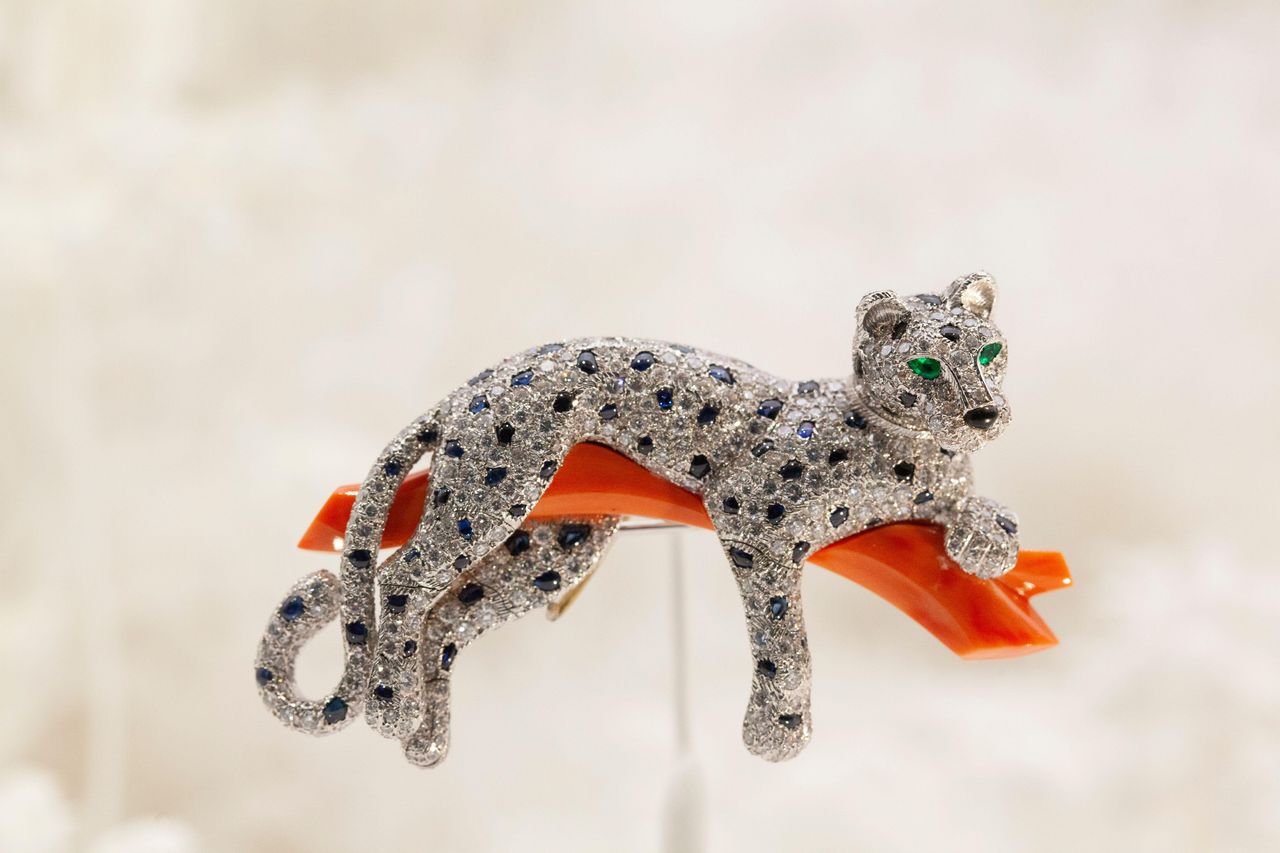
Due to their timeless appeal and Cartier’s impeccable craftsmanship, pieces retain significant value over time.
(Image credit: Susannah Lovis)
Scarisbrick then chronicled the motif’s history, from lion pendants cast by Greek goldsmiths in 7BC, to the panther cameo ring worn by Prince Eugene of Savoy (1663-1736). The Prince was a brilliant military commander who, alongside the Duke of Marlborough, fought against and defeated the armies of Louis XIV. As stylish as he was savvy, his ring was carved from intricately patterned moss agate, by Roman artisans.
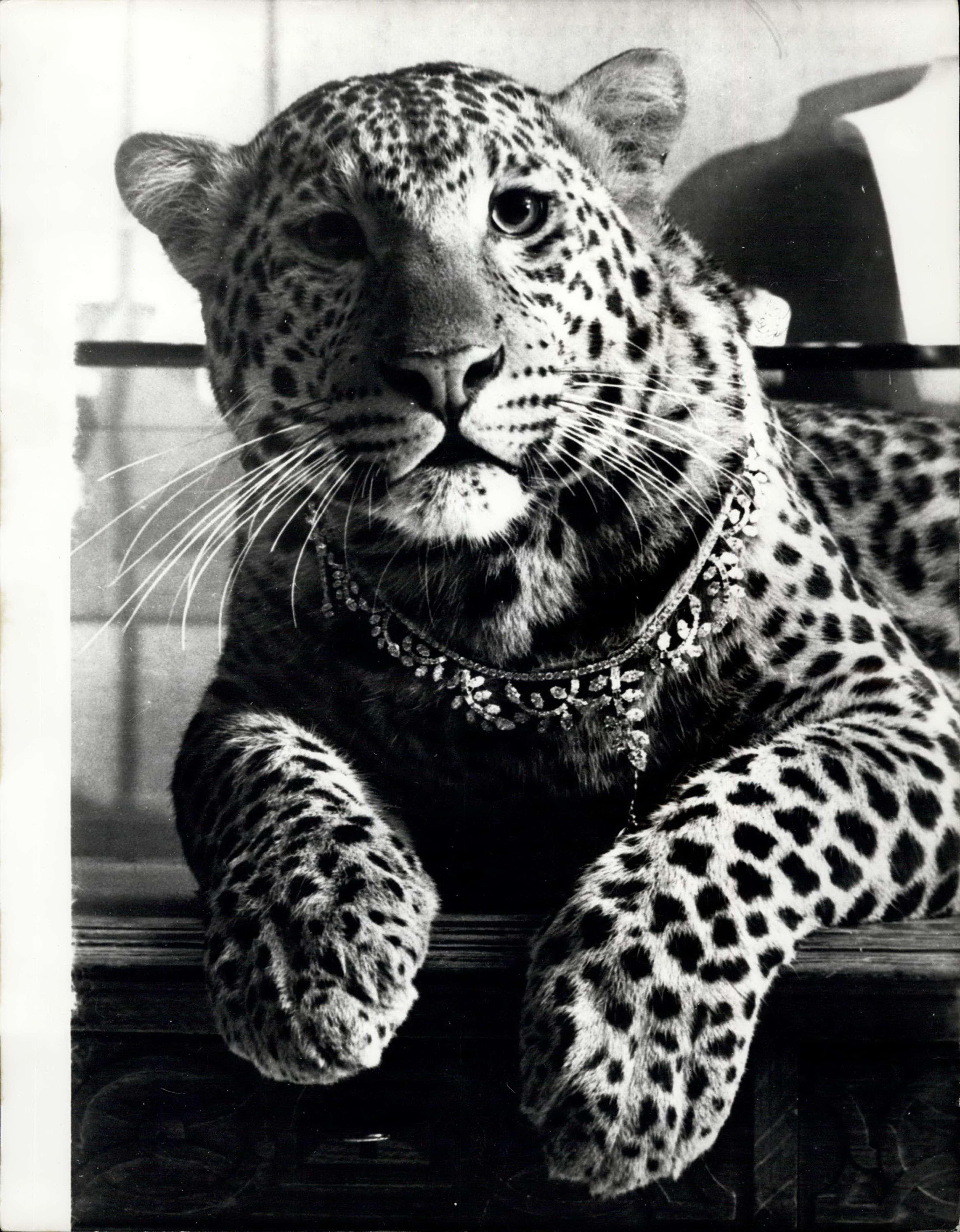
In 1964, Cartier called on Rina — star model of a new agency for animals — to show a diamond saltire with 21-carat emerald pendant.
(Image credit: Alamy)
Big cats also inspired jewellery creations at the start of the 20th century: in Cartier’s Parisian ateliers, a 1915 bejewelled wristwatch was set with diamonds and onyx in tribute to the panther’s piebald pelt. The stealthy cats soon became synonymous with the important maison. Jeanne Toussaint, director of fine jewellery from 1933 to 1970, was nicknamed ‘panthere’; Peter Lemarchand, a designer from 1927 until his death in 1970, released them from the constraints of stylisation and brought them to life following long hours of observation at the Vincennes zoo, followed by intensive study of the Egyptian bronze figures of the cat goddess, Bastet, in the Louvre.
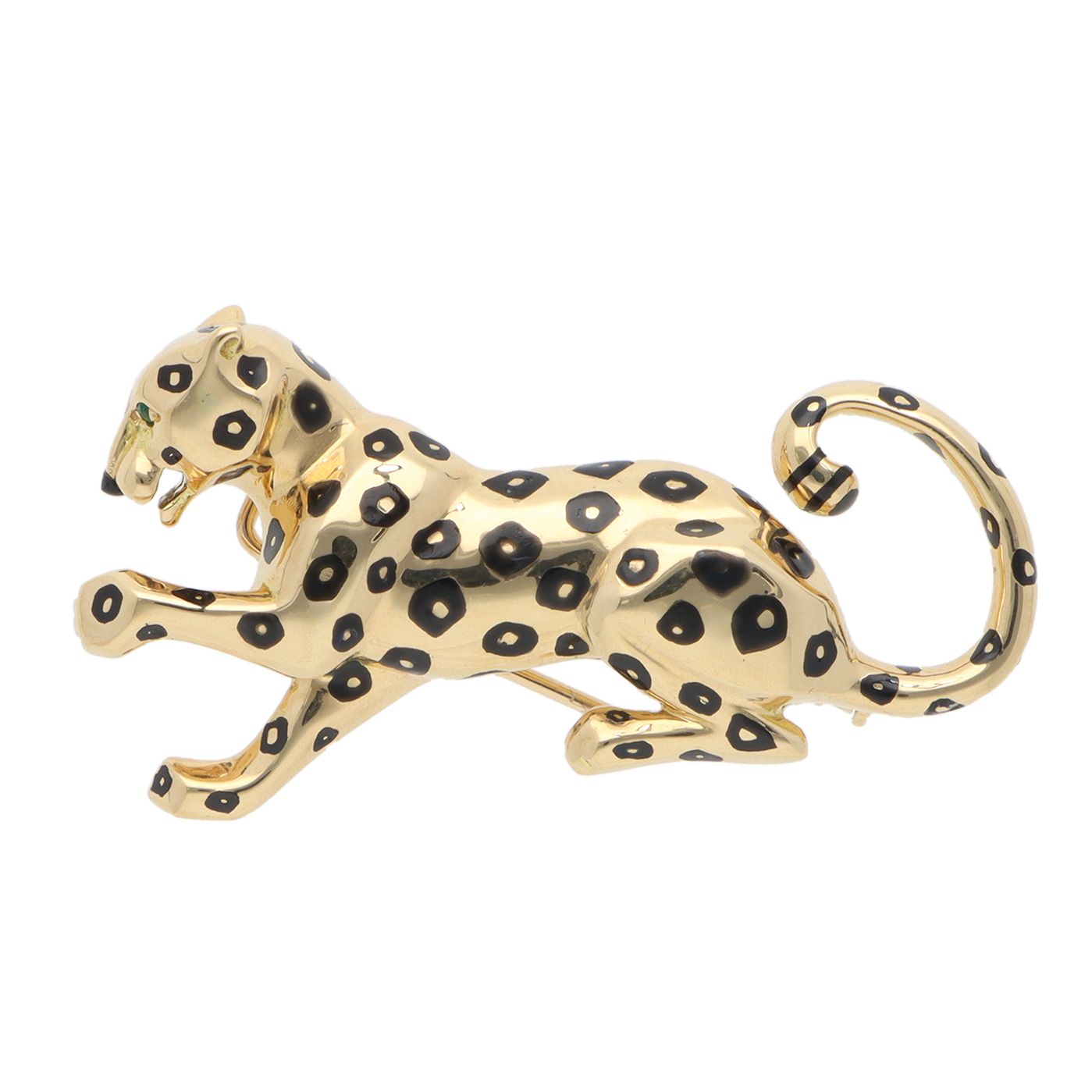
As such, panther-shaped Cartier jewels are scattered across decades. In London, at expert dealer Susannah Lovis’s Burlington Arcade set-up, my vintage finds include a yellow gold panther brooch patterned with hand-applied black enamel and decorated with glinting emerald eyes (above), and a Cartier Panthère Lakarda ring in yellow gold, cleverly constructed to wrap around the finger. Both date to the nineties.
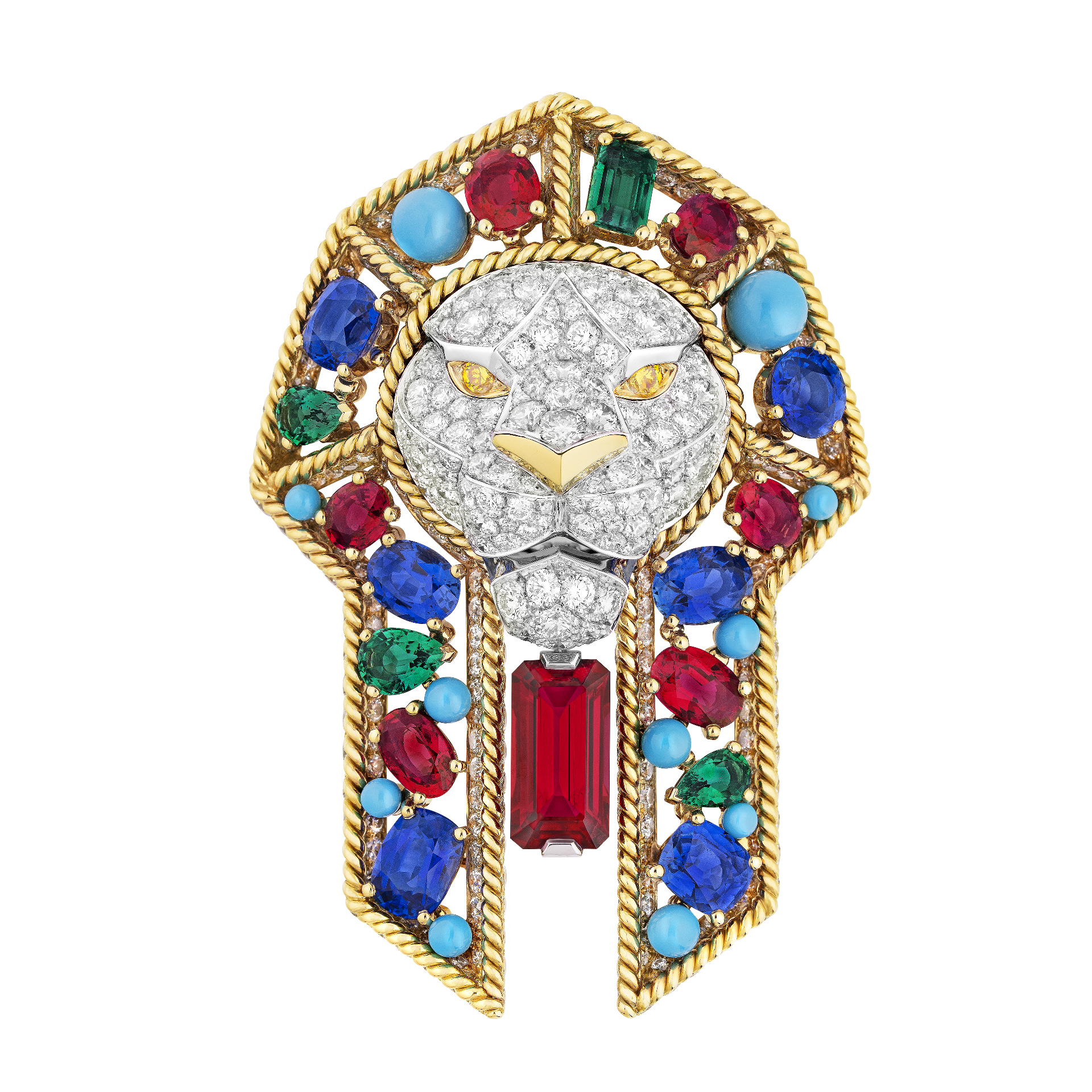
The centrepiece of CHANEL’s Lion Emblematique brooch is a baguette-cut ruby totalling 2.68 carats. Often used to represent physical might and resilience, lions in jewellery can also act as a talisman to give the wear fearlessness during hard times.
(Image credit: CHANEL)
Another wild cat, the lion, has assumed authority of CHANEL. Its use in jewellery — in addition to fashion and beauty (it lent its name to the Le Lion Eau de Parfum, by in-house perfumer Olivier Polge) — is inspired by Gabrielle ‘Coco’ Chanel. The house’s founder was born under the Leo star sign and lived her life surrounded by likenesses of the animal. Lion Emblematique is the name of one chapter of the brand’s latest high jewellery collection, Signes & Symboles. Among the treasures is the Lion Puissant necklace in white gold set with white diamonds, and the magisterial Lion Emblematique white, rose and yellow gold brooch, its mane frosted with yellow diamonds, white diamonds, rubies, sapphires, emeralds and turquoise.
It’s all about the snake at Bvlgari. The Italian maison, which was founded in 1884 Rome by Greek master silversmith Sotirios Voulgaris, presented its first Serpenti bracelet watch in 1948. The now iconic creation was fitted with a tactile, scaley Tubogas bracelet, in homage to both Roman and Greek mythology which promoted the reptile as a symbol of healing, renewal and protection. The first watch soon evolved into a larger collection of timepieces, and went on to inspire necklaces, rings and more. Among this year’s snake-like novelties is a pink gold Serpenti ring set with two pear-shaped sapphires, 22 fancy sapphires and 132 pavé-set diamonds (below).
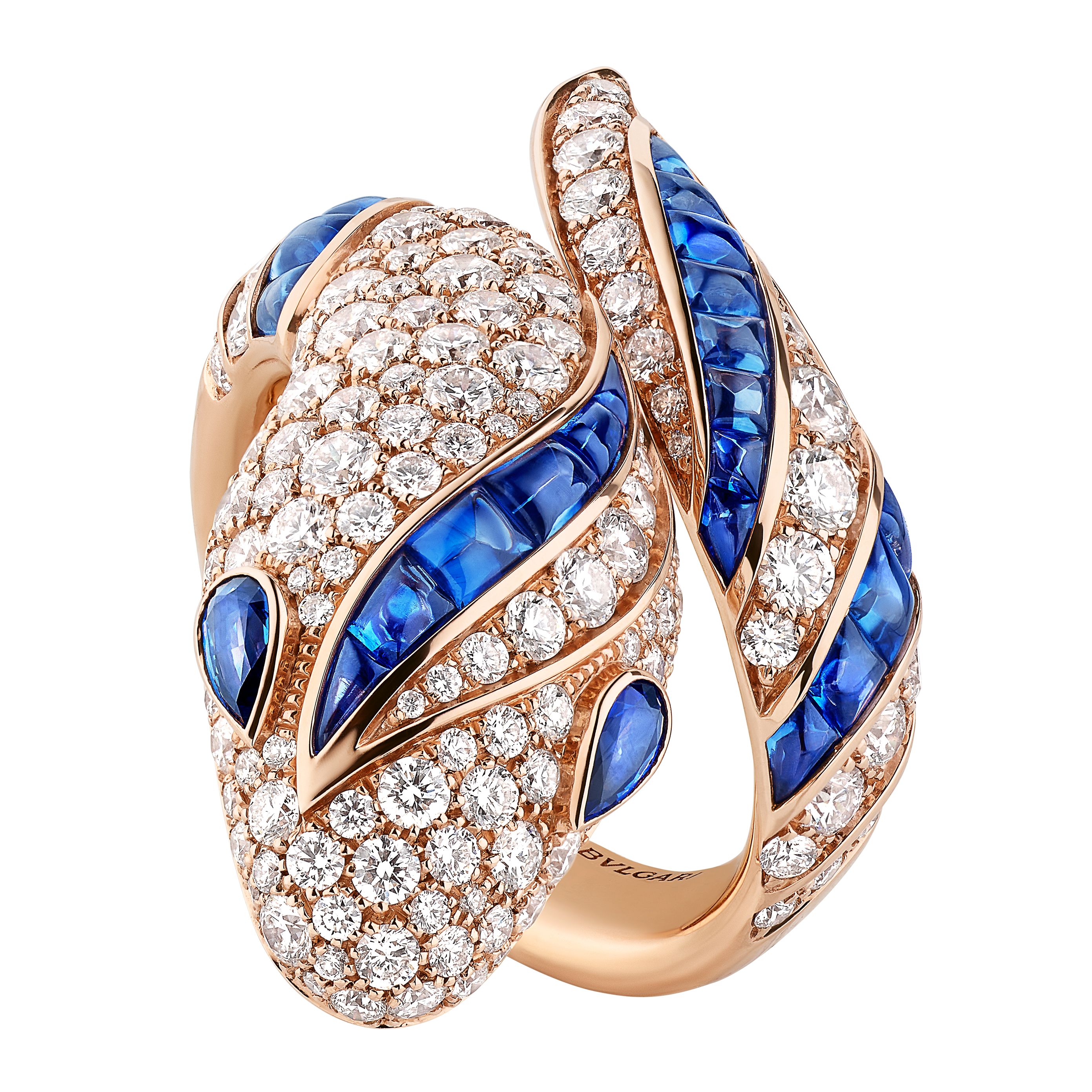
Snake jewellery was popularised in the Victorian era after Prince Albert gave Queen Victoria an emerald-set snake engagement ring, representing eternal love and fidelity.
(Image credit: Bvlgari)

Jean Schlumberger was was one of the leading jewellery designers of the 20th century and synonymous with Tiffany & Co..
(Image credit: Getty Images)
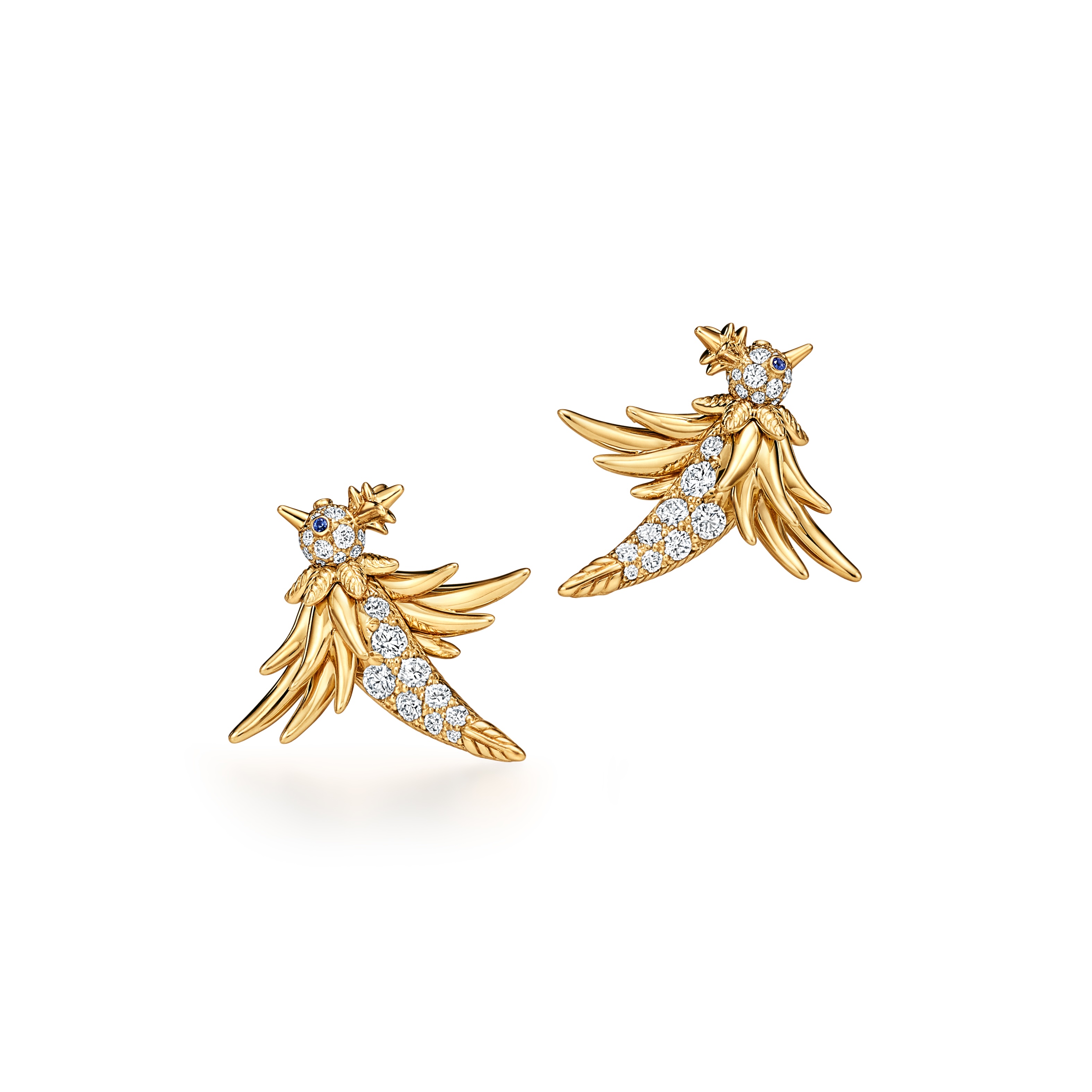
Avian mascots have been all the rage at Tiffany & Co. ever since important jewellery designer Jean Schlumberger dreamt up his Bird on a Rock design, a gold and gem-encrusted cockatoo perched happily on top of a large, colour gemstone in 1965. Schlumberger was stirred into action by the exotic birds he saw while travelling through the Caribbean and Asia. There have been myriad variations of the Bird on a Rock since including, in September, Bird on a Rock Feathers, a new high jewellery suite that seeks to celebrate the bird’s plumage. Rings, earrings and more have been assembled from individually sculpted and carefully interlocking feathers in gold and platinum. Some of the pieces are studded with diamonds.
Image 1 of 2
Insects, too, make for mascots in jewellery design. Bees have been important to Chaumet since 1804, when founder Marie-Étienne Nitot became the official jeweller to Napoleon Bonaparte. The emperor chose the golden bee to replace the royal fleur-de-lis of the old Bourbon monarchs, not only to signal the changing of the guard, but to establish deep historical ties with France’s oldest sovereigns — and, therefore, project his own legitimacy. In 1653, golden bee-like ornaments (it turns out they were actually cicadas) were discovered in Tournai in the tomb of Childeric I, the founder of the Merovingian dynasty, the ruling family of the Frankish peoples from the 5th century until 751, and father of Clovis.
The Place Vendôme maison pays tribute to its illustrious history, by continuing to author bee-influenced designs across high and fine jewellery collections. Two dinky bees decorate a white gold, diamond and sapphire ring. Less figurative pieces lean into geometric honeycomb patterns.
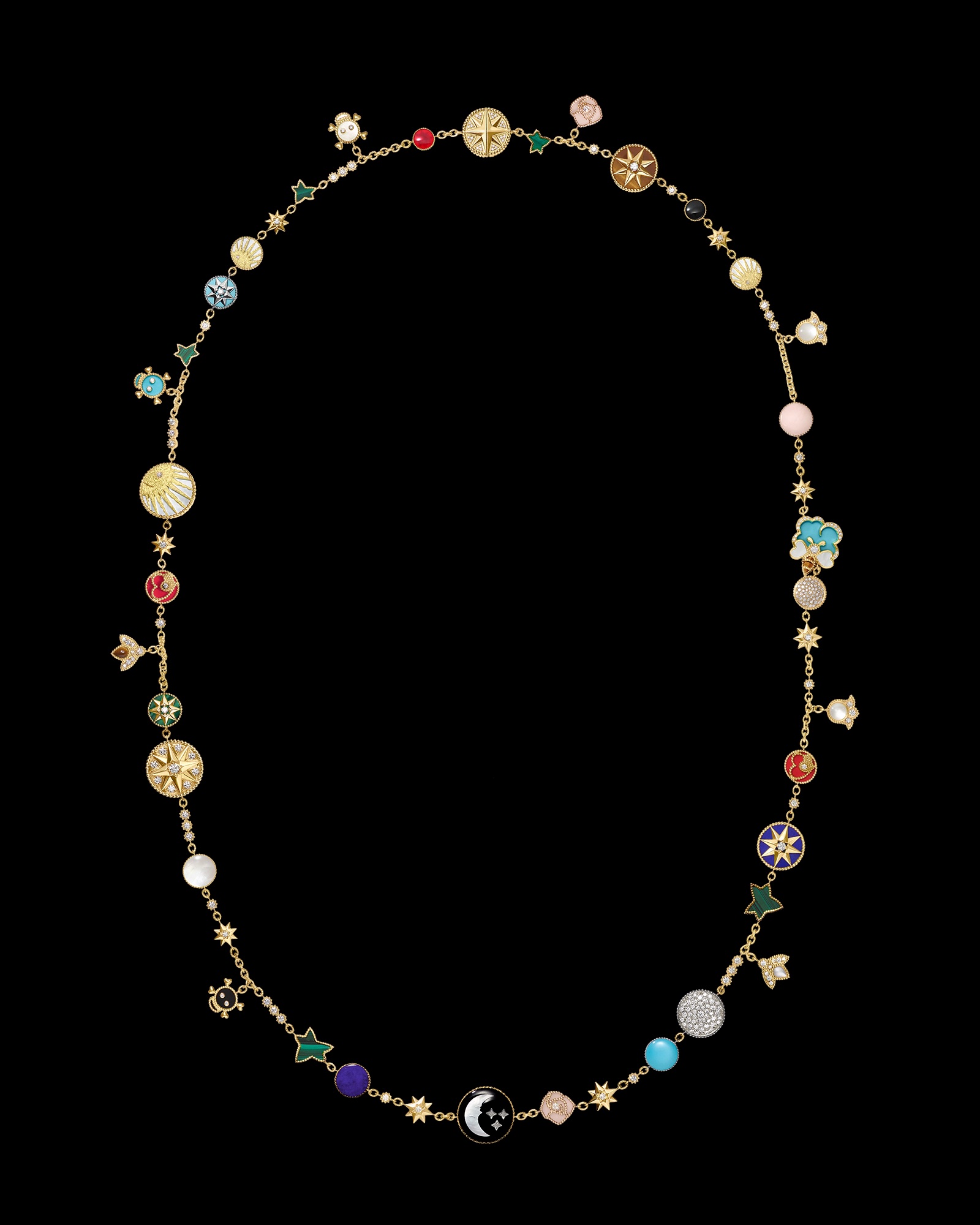
Bees are popular motifs representing hard work, cooperation and the sweetness of life.
(Image credit: Dior)
The bee is also a mascot at Dior. In his memoirs, Christian Dior likened his Paris atelier at 30, Avenue Montaigne to ‘a little beehive bursting with activity’, populated by his ‘bees’, or highly skilled seamstresses. A Rose des Vents multi-charm necklace, which launched this month, buzzes with tiny gold, diamond and hardstone bees (above).
Earlier this year, Van Cleef & Arpels debuted their Lucky Spring collection and butterflies feature in five pieces, including a brooch and a long necklace — the delicate animal’s wings rendered in lapis lazuli and blue agate, to match the green agate foliage and mother-of-pearl flowers.
Van Cleef & Arpels is also known for its long love affair with ladybirds, dating back to the 1930s. In the Lucky Spring offering, the traditional good luck charm appears in rose gold, onyx and red carnelian form, in rings, bracelets and a stand-out long necklace. The plucky, polka-dot beetle is a favourite of the Country Life team too, and we’ve hidden a picture of one on every front cover since the middle of 2019.
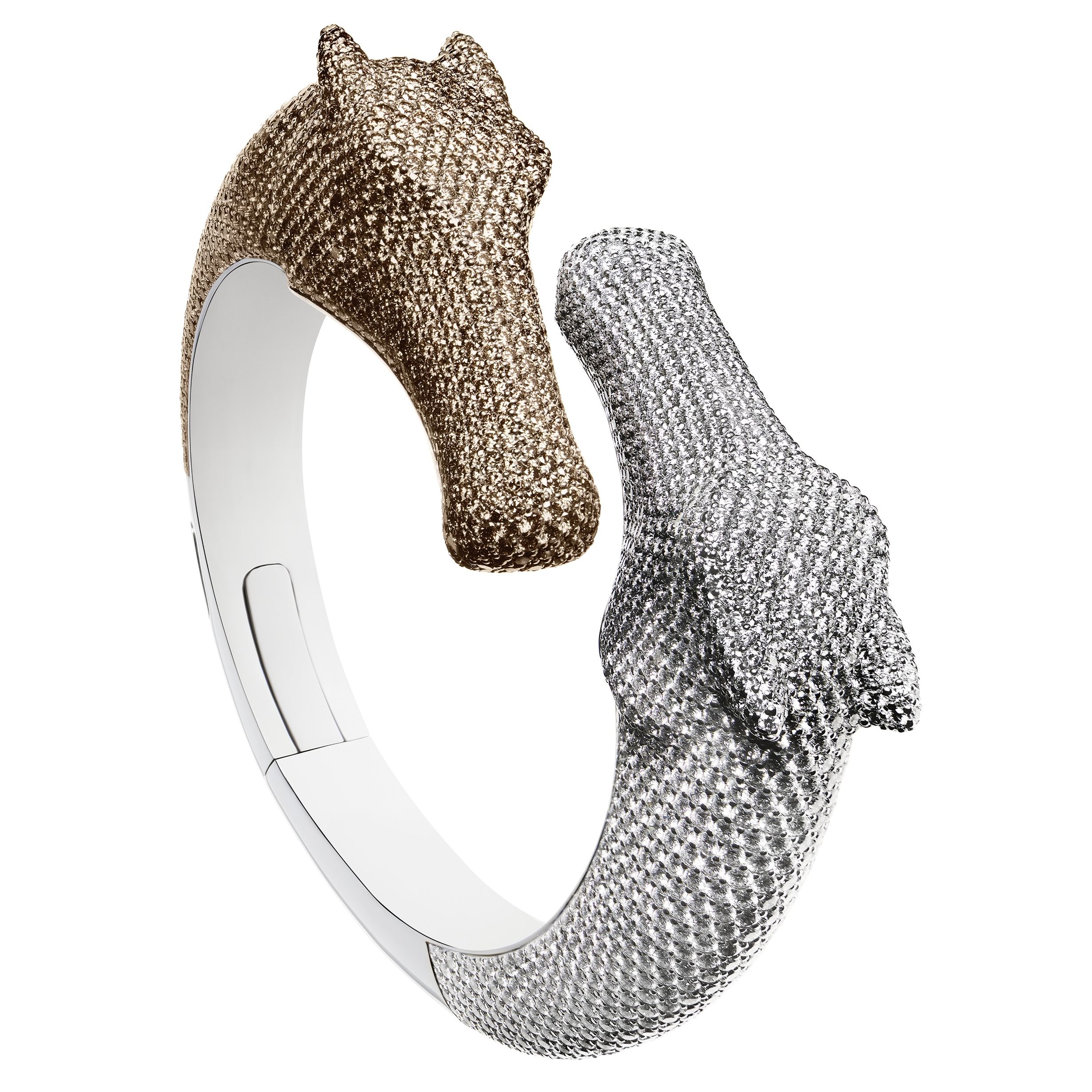
Ancient cultures viewed ownership of horses as a mark of high social rank and wealth.
(Image credit: Hermès)
Last, but by no means least, to horses, who reign supreme at Hermès. The luxury French brand’s former chairman, Jean-Louis Dumas, once said that the majestic creatures were their first clients — a nod to the fact that Hermès started life as a harness and saddlery workshop.
Hermès’s new high jewellery collection, Into the Horsescape, celebrates this rich equine heritage. It totals 90 pieces — the largest offering to date — 22 of which are one-of-a-kind. Look out for the Galop Hermès cuff whose two sculptural horse’s heads hug the wrist and more abstract, horseshoe-adjacent pieces from the Centaur chapter.